Patient Journey Automation in Healthcare: A 2026 Guide
By Rowena Tulacz · · 10 min read
TL;DR: Patient journey automation uses AI and workflow logic to orchestrate the full care cycle, reducing no-shows and administrative burdens. It requires detailed workflow mapping, reliable EHR triggers, and human oversight to ensure personalized, seamless care experiences.
Patient journey automation in healthcare is the use of AI-powered workflow orchestration to manage the complete patient lifecycle, from initial contact through post-treatment follow-up, by automating routine tasks and coordinating care across systems and teams. The industry term for this practice is patient journey orchestration. When implemented correctly, it reduces no-show rates, cuts administrative overhead, and delivers personalized patient experiences without adding staff. This guide explains how it works, what it delivers, and where human oversight remains non-negotiable.
What does patient journey automation mean in healthcare?
Patient journey automation uses AI and workflow logic to optimize the patient lifecycle from onboarding through post-treatment follow-up. It goes well beyond "if this, then that" automation. The system maps each stage of the care cycle, adjusts scheduling dynamically, triggers personalized outreach, and escalates follow-ups based on patient behavior or clinical events.

The foundational concept is patient journey mapping, which identifies every touchpoint a patient encounters across their care experience. Automation then assigns triggers, timing, and ownership to each of those touchpoints. The result is a coordinated sequence of actions that runs reliably without manual intervention at every step.
What separates this from basic EHR/EMR task management is scope. Native EHR tools handle clinical documentation well, but they rarely coordinate the full administrative and communication workflow that surrounds a care episode. Patient journey automation fills that gap by connecting scheduling platforms, communication tools, billing systems, and care team notifications into a single orchestrated flow.
How patient journey automation works across systems and teams
Workflow orchestration coordinates timing and sequence across systems. Each care step, from referral to consult to diagnostics to procedure to follow-up, becomes a discrete workflow node with its own trigger, assigned owner, and outbound communication.
Here is how a typical automated patient navigation sequence operates:
- Referral received: The EHR event triggers an automated notification to the scheduling team and a welcome message to the patient.
- Appointment confirmed: The system sends confirmation via the patient's preferred channel, whether Push notification, SMS, or WhatsApp.
- Pre-visit preparation: Intake forms, insurance verification requests, and pre-procedure instructions are sent at timed intervals.
- Day-of reminders: Automated reminders reduce no-shows by keeping the appointment top of mind.
- Post-visit follow-up: Discharge instructions, satisfaction surveys, and next-appointment prompts are triggered automatically after the encounter closes.
| Workflow element | Manual process | Automated process |
|---|---|---|
| Appointment reminders | Staff calls or emails each patient | System sends timed multi-channel reminders |
| Intake form collection | Mailed or handed out at check-in | Sent digitally upon scheduling confirmation |
| Referral tracking | Coordinator checks status manually | Trigger fires when referral status changes in EHR |
| Follow-up scheduling | Staff contacts patient after visit | Automated prompt sent within 24 hours of discharge |
| Escalation for no-response | Depends on staff availability | System escalates to care team after defined wait period |
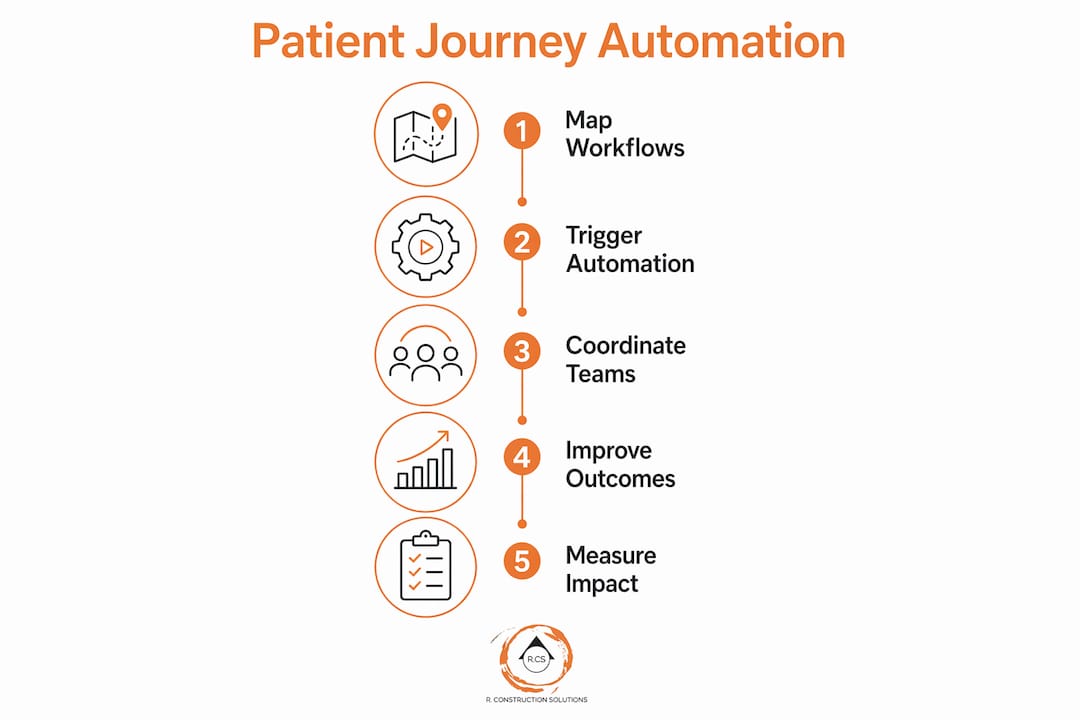
Pro Tip: Map every workflow node before selecting a technology platform. If you cannot name the trigger, the owner, and the outbound action for each step, the automation will have gaps.
What are the primary benefits of patient journey automation?
The benefits fall into three categories: operational efficiency, patient experience, and staff capacity. Automated patient navigation reduces no-show rates from 15 to 20 percent down to single digits within approximately 60 days of deployment.
Prior authorization delays cause physicians to spend 13 hours weekly on administrative work alone. AI-assisted automation reduces that burden by accelerating data gathering, pre-populating forms, and flagging incomplete submissions.
For patients, the benefit is consistency and clarity. Automation reduces duplicate data entry and repetitive tasks, which also improves data accuracy across the care record.
Key operational KPIs to track:
- No-show rate: Baseline versus post-implementation, measured monthly
- Time to appointment: Days from referral to confirmed visit
- Prior authorization turnaround: Hours from submission to decision
- Patient satisfaction scores: Collected via automated post-visit surveys
- Staff time on administrative tasks: Tracked via time-study or EHR audit logs
How to balance automation with human oversight and patient experience
Human-in-the-loop governance keeps clinical decisions with clinicians while allowing AI to accelerate administrative tasks. Patient experience automation must remove friction without making patients feel ignored. The "digital front door" works well when paired with clear escalation paths to a human.
Pro Tip: Build your escalation logic before you build your automation sequences. Every automated workflow should have a defined point at which a human is notified.
Real-world examples of patient journey automation in practice
Automated patient onboarding
Automated onboarding triggers secure digital messages the moment a new patient is added to the EHR: welcome messages, intake forms, insurance verification requests, and appointment confirmations.
Dynamic scheduling in diagnostics
Dynamic scheduling automation monitors result status in the EHR and adjusts downstream appointment timing automatically, so patients don't arrive for a consult before their results are ready.
Prior authorization acceleration
AI agents gather clinical documentation, pre-populate authorization forms, and submit to payers. Physicians review and approve before submission.
Multi-step care coordination in oncology
Automation coordinates referrals, imaging, pathology, tumor board scheduling, treatment planning, and follow-up into a single orchestrated workflow.
Key takeaways
| Point | Details |
|---|---|
| Core definition | AI and workflow logic manage the full care lifecycle from onboarding to follow-up. |
| No-show reduction | No-show rates drop from 15–20 percent to single digits within 60 days. |
| Human oversight is required | Clinical decisions remain with clinicians. |
| EHR triggers are foundational | Reliable automation depends on EHR events firing workflows automatically. |
| KPI tracking drives ROI | Set baseline metrics before go-live. |
Why workflow mapping is the step most organizations skip
I have worked with healthcare administrators who invested in automation platforms before they could describe their own workflows in writing. The platform automated the chaos instead of the process. The organizations that see the fastest results treat workflow mapping as a clinical operations project, not an IT project.
Automation that fires too frequently, uses the wrong channel, or sends generic messages trains patients to ignore communications. Personalization is what separates effective patient experience automation from digital noise. Explore AI-powered workflow tools to see where this is heading.
— Rowena
How BizOps helps healthcare organizations automate patient workflows
BizOps builds Go High Level automation for clinics that connects scheduling, communication, and care coordination into a single managed workflow — automated patient communications, appointment reminders, and multi-step care pathways without adding administrative headcount. Explore healthcare automation solutions at BizOps.
FAQ
What does patient journey automation mean in healthcare?
It is the use of AI and workflow logic to manage the complete patient lifecycle, from onboarding through post-treatment follow-up.
How does patient journey automation reduce no-show rates?
Timed, multi-channel reminders at 72 hours, 24 hours, and 2 hours before appointments reduce no-show rates to single digits within about 60 days.
Which healthcare workflows benefit most from automation?
Appointment reminders, new patient onboarding, prior authorization, post-discharge follow-up, and referral tracking.
Recommended
Want this set up for your business?
Book a free 30-minute strategy call and we'll map out your automations together.
Book a Free Call