The Role of CRM in Fitness Studios: 2026 Guide
By Rowena Tulacz · · 9 min read

Most fitness studio owners think of their CRM as a glorified scheduling tool. Book a class, process a payment, done. But that framing leaves serious money on the table. The role of CRM in fitness studios goes far deeper than logistics. A well-configured customer relationship management system tracks every touchpoint in a member's journey, from the first Instagram click to their third membership renewal. It automates follow-ups, flags churn risk before you lose the member, and gives you the data to make smarter decisions about growth. This guide breaks down exactly how to use it.
Table of Contents
- Key Takeaways
- The role of CRM in fitness studios, explained
- How CRM reduces churn and stops revenue leakage
- Comparing CRM software options for fitness studios
- Implementing CRM strategically in your studio
- My honest take on CRM adoption in fitness studios
- How Byrcs can strengthen your studio's CRM results
- FAQ
Key Takeaways
| Point | Details |
|---|---|
| CRM goes beyond scheduling | A fitness CRM manages lead capture, member lifecycle, churn alerts, and revenue reporting in one place. |
| Churn signals are trackable | Attendance drops and failed payments are measurable triggers that CRMs can catch before a member cancels. |
| Staged rollout beats big-bang adoption | Activating CRM features in sequence prevents overwhelm and drives faster revenue impact. |
| Workflow fit beats feature count | The best CRM for your studio is the one that maps to your actual member lifecycle, not the one with the longest list. |
| KPIs make CRM accountable | Track lead response time, renewal rate, and class fill rate to measure whether your CRM is actually working. |
The role of CRM in fitness studios, explained
Customer relationship management (CRM) in fitness is the practice of using software to manage every interaction a member or prospect has with your studio. The term gets used loosely, so it helps to be specific. A CRM in this context is not just a database. It is an active system that captures leads, triggers communications, tracks behavior, and reports on outcomes.
The core functions that matter most for fitness studios break down like this:
- Multi-channel lead capture. Members find you through Google searches, Instagram ads, walk-ins, and referrals. A CRM pulls those leads into a single pipeline so nothing slips through. Lead capture across channels is one of the most cited benefits of a well-configured fitness CRM.
- Automated follow-up sequences. When someone books a free trial, the CRM sends a confirmation, a reminder, and a post-visit check-in without anyone on your team lifting a finger. Customized automation of workflows from lead capture through trial to advocacy directly improves conversion rates.
- Attendance and booking history. Every class a member attends, every no-show, every booking cancellation gets logged. This history becomes the foundation for personalized outreach and churn detection.
- Role-based access. Front desk staff see member check-in data. Trainers see client progress notes. Managers see revenue dashboards. Everyone works from the same system without stepping on each other's data.
- Centralized member records. One profile per member, updated in real time, accessible to anyone who needs it.
Pro Tip: Before you evaluate any CRM software, map out your current member lifecycle on paper. Where do leads come from? What happens after a trial? When do renewals trigger? That map tells you which CRM features you actually need versus which ones just look impressive in a demo.
How CRM reduces churn and stops revenue leakage
Retention is where CRM pays for itself most clearly. The average fitness studio loses members quietly. They stop booking classes, their payment fails once, and then they ghost. By the time you notice, they are already signed up somewhere else.
A properly configured CRM changes that pattern by surfacing churn risk before it becomes a cancellation. Here is what a structured intervention sequence looks like in practice:
- Attendance trigger. The CRM flags any member who has not booked a class in 14 or more days. Churn risk signals like this, along with attendance below baseline and failed payments, can be automatically detected and acted on.
- Automated re-engagement message. The system sends a personalized text or email. Not a generic promo blast. A message that references their last class, their trainer, or a program they enrolled in.
- Staff alert. If the member does not respond within 48 hours, the CRM assigns a task to a staff member to make a personal call.
- Renewal flow. Sixty days before a membership expires, the CRM starts a renewal sequence: a reminder, a loyalty offer, and a direct booking link.
- Win-back campaign. Members who cancel get a separate sequence triggered 30 days later, designed to bring them back at a reduced rate or with a new program offer.
"Intervention programs built on CRM churn signals save 15–30% of at-risk members within 90 days. That is not a marginal improvement. For a studio with 300 members, that is 45 to 90 people who would have walked out the door."
The difference between this approach and generic outreach is specificity. Generic emails get ignored. Behavior-triggered messages that reference real activity get opened. Studios that use automated retention strategies see measurably better renewal rates because the communication feels relevant rather than mass-produced.
Comparing CRM software options for fitness studios

Not all CRM platforms are built the same way, and the wrong choice creates more friction than it solves. The core trade-off in the market sits between fitness-specific platforms and general-purpose CRMs.
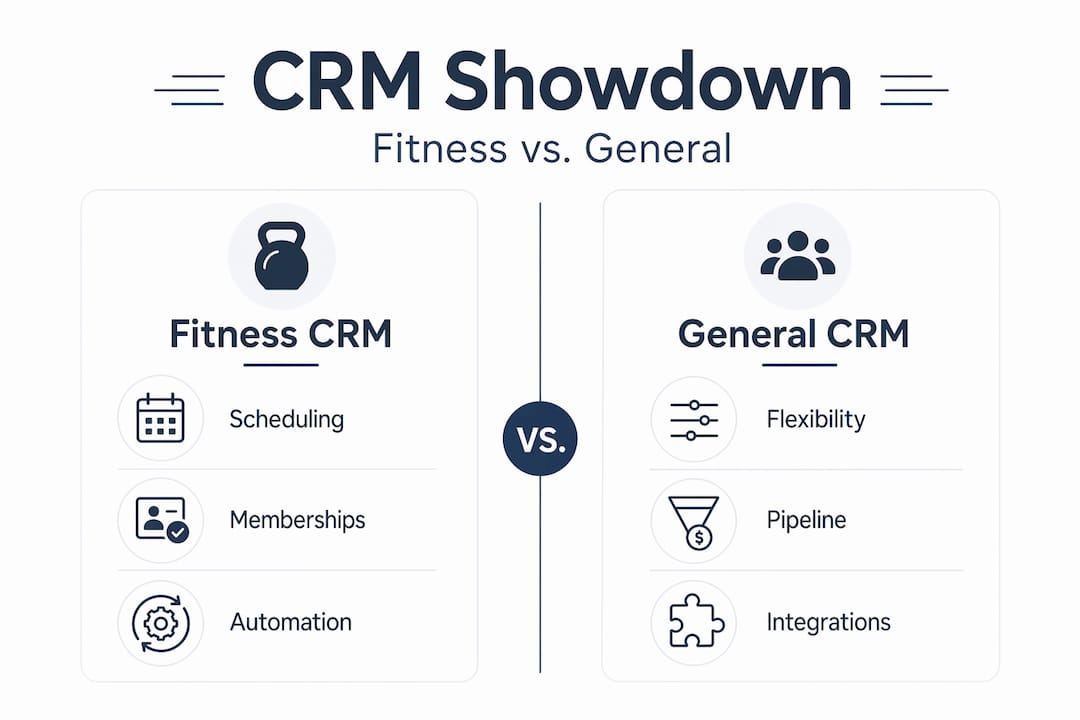
Fitness-specific CRMs excel at scheduling and membership management, while general CRMs often provide more pipeline flexibility and integration depth. Neither is universally better. It depends on where your biggest operational gaps are.
| Platform | Best for | Key strength | Limitation |
|---|---|---|---|
| Mindbody | Multi-location studios | Deep scheduling and class management | Complex setup, higher cost |
| PushPress | Independent gyms | Clean membership management | Limited marketing automation |
| Fuzen | Growth-focused studios | Workflow customization and automation | Newer platform, smaller user base |
| Mako CRM | Independent wellness studios | Real-time P&L, churn risk, unit economics | Focused on smaller operations |
One factor that rarely gets enough attention in software comparisons is email and SMS integration. Most fitness CRMs have native messaging tools, but integrating with platforms like Klaviyo, Mailchimp, or ActiveCampaign gives you significantly better segmentation and targeting than what is built in.
Pro Tip: When evaluating CRM software, ask the vendor to show you specifically how their platform handles a free trial conversion sequence and a churn re-engagement flow. If they cannot demo those two workflows clearly, the platform probably will not serve your retention goals well.
Pricing matters too, but it should be the last variable you evaluate, not the first. A cheaper platform that does not fit your workflows costs more in lost revenue than a more expensive one that actually gets used.
Implementing CRM strategically in your studio
Most studios that struggle with CRM do not have a software problem. They have an implementation problem. They activate every feature at once, the team gets confused, and within three months the system becomes a digital filing cabinet nobody trusts.
A staged rollout fixes this. Activating CRM features sequentially starting with trial follow-up, then onboarding flows, then churn alerts, and finally email and SMS integration maximizes revenue impact with the least configuration chaos. Here is how to structure it:
- Week 1 to 2: Free trial follow-up. Set up the automated sequence that fires when someone books a trial. Confirmation, reminder, and post-visit message. This is the highest-ROI workflow in any fitness CRM and takes a few hours to configure.
- Week 3 to 4: Member onboarding. Build the sequence that runs for a new member's first 30 days. Welcome message, class recommendations, check-in at day 7, and a milestone note at day 30.
- Month 2: Churn alert activation. Configure the attendance and payment triggers. Define what counts as a risk signal for your studio specifically. A yoga studio and a CrossFit box have different attendance patterns.
- Month 3: Email and SMS platform integration. Connect your CRM to a dedicated messaging platform for better segmentation and design. This is where appointment setting automation becomes genuinely powerful, because you can trigger messages based on real member behavior.
Once the system is running, you need KPIs to know whether it is working. Key metrics to track include lead response time, conversion rate, renewal rate, class attendance rate, and trainer utilization. Review these monthly. If your renewal rate is not improving after 90 days of running renewal sequences, the workflow needs adjustment, not more features.
Staff training is the piece most owners skip. Assign clear roles in the CRM from day one. Who owns lead follow-up? Who handles churn alerts? Who reviews the weekly dashboard? Without ownership, tasks pile up and the system stops being trusted.
My honest take on CRM adoption in fitness studios
I have seen studios spend thousands on CRM software and then use it for exactly two things: scheduling and payment collection. That is like buying a commercial kitchen and only using it to make toast.
The misconception I keep running into is that more features equal a better CRM. They do not. The best fitness CRM is the one whose workflows align precisely with your member lifecycle. A platform with 200 features that nobody uses is worse than a simpler system that your whole team actually trusts.
What I have learned from watching studios succeed and fail with CRM is that the ones who get results start with one workflow, get it right, and then expand. They do not try to automate everything in month one. They fix the most expensive leak first, which is almost always the trial-to-membership conversion, and then work outward from there.
The studios that struggle are the ones that treat CRM as an IT project rather than an operations decision. Your front desk team, your trainers, and your managers all need to understand what the system does for them personally. When staff see that the CRM saves them from awkward "did you renew?" conversations because the system handled it automatically, they become advocates for using it properly.
CRM is not a magic fix. But when it is configured around your actual workflows and your team knows how to use it, it becomes the most reliable revenue protection tool you have.
— Rowena
How Byrcs can strengthen your studio's CRM results
Running a fitness studio means wearing too many hats at once. The last thing you need is a CRM that creates more manual work instead of less.
Byrcs builds automation workflows specifically for service businesses, including fitness studios, through its Go High Level automation services. That means your trial follow-ups, renewal sequences, and churn re-engagement flows get built and configured to match your actual member lifecycle. Not a generic template. Not a one-size-fits-all setup. Byrcs clients see an average 30% revenue increase and 50% reduction in manual tasks after implementation. If your CRM is sitting underused or your team is still chasing leads manually, explore the full automation service options and see what a properly configured system looks like for a studio your size.
FAQ
What is the role of CRM in fitness studios?
A CRM in a fitness studio manages lead capture, member communication, attendance tracking, and renewal automation from a single platform. It replaces scattered spreadsheets and manual follow-ups with automated workflows tied to real member behavior.
How does CRM help with member retention in gyms?
CRM systems detect churn signals like attendance drops and failed payments, then trigger automated re-engagement messages before the member cancels. Structured CRM interventions can save 15 to 30 percent of at-risk members within 90 days.
What CRM features matter most for fitness studios?
The highest-impact features are trial conversion sequences, onboarding flows, churn alert triggers, and renewal automation. These four workflows address the most common revenue leakage points in a typical studio operation.
Should I use a fitness-specific CRM or a general CRM?
Fitness-specific platforms handle scheduling and memberships better out of the box, while general CRMs offer more pipeline flexibility. The right choice depends on your biggest workflow gap. Start there, not with the feature list.
How do I measure whether my CRM is working?
Track lead response time, trial conversion rate, membership renewal rate, and class attendance trends monthly. If those numbers are not improving within 90 days of activating a workflow, the sequence needs to be adjusted.
Want this set up for your business?
Book a free 30-minute strategy call and we'll map out your automations together.
Book a Free Call